
CONTACT US
Large U.S. Consumer Finance Issuer Builds a Graph-Powered Fraud Investigation Platform with Graphable and Neo4j

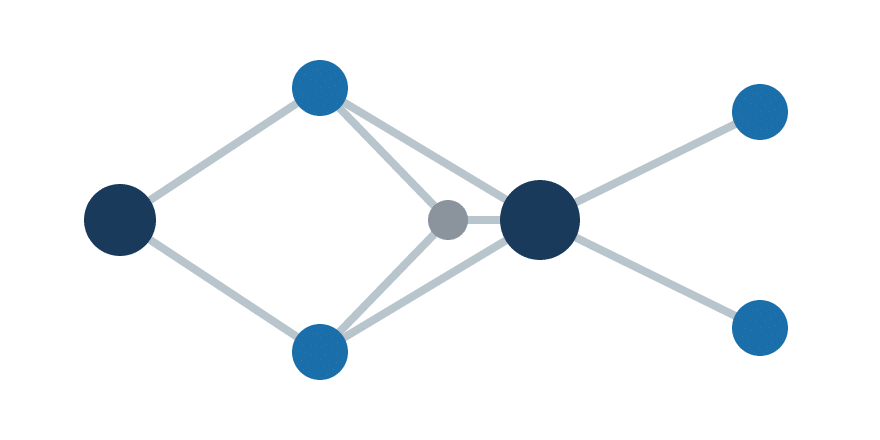
Large U.S. Consumer Finance Issuer
Industry
Financial Services, Consumer Finance / Credit Cards
Use Case
Fraud detection and investigation on a Neo4j graph database.
Goal
Decrease annual fraud losses and equip investigators with better tools.
Challenge
Fraud signals sat in many separate source systems, so connections between accounts, calls, and activity were hard to see.
Solution
A phased Neo4j graph build: data model, detection rules in Cypher, visual investigation tooling, and hands-on enablement for the client’s team.
Results
A working graph platform that generates alerts and cases, extended across successive phases to more data sources and rules, with client staff trained to run it.
Large U.S. Consumer Finance Issuer
A large U.S. consumer-finance and credit card issuer set out to cut fraud losses and give investigators better tools — by modeling data from many source systems as one connected graph, and turning that graph into alerts, cases, and visual investigation.
The Company
This U.S. consumer-finance company issues credit cards and financing programs through a broad network of partners. At that scale, even a small share of fraudulent activity adds up to real losses — and to a large investigation workload.
The Challenge
Fraud rarely shows up in a single record. It shows up in relationships — the same phone number reaching several accounts, a pattern of non-monetary changes followed by a transaction, a cluster of authorizations that only looks suspicious when viewed together. But the data that holds those clues lived across multiple systems, in the shape each system needed rather than the shape an investigator needed.
The company decided to prioritize a graph-based approach: model data from many sources in a graph database, detect suspicious patterns as rules, and give investigators a visual way to follow the connections.
Industry insight: The Nilson Report estimates that worldwide card fraud losses reached $33.83 billion in 2023.
The Solution
Graphable worked with the company’s fraud and technology teams over several statements of work, building on Neo4j and delivering in waves as new source data became available. The work included:
- A graph data model and architecture that brings data from multiple source systems into Neo4j, with documentation the client’s team could own.
- Cypher code to load, validate, and analyze fraud data as each new wave of source files was added.
- Fraud-detection rules expressed as graph queries across account, call, and authorization activity, producing alerts that roll up into cases.
- Visual investigation tooling in Linkurious, refined repeatedly from investigator feedback so the views matched how analysts actually work.
- Documentation of the rule, report, and process inventory, plus weekly status reporting.
- Hands-on enablement — a built-in share of each phase was one-to-one training for client staff and third-party providers on Neo4j, Cypher, graph visualization, and fraud-investigation pipelines.
The Results
Each phase was scoped against clear acceptance criteria: a graph initiative that produces alerts and cases, accepted architecture documentation, working Cypher code, and trained client personnel. Over successive phases the company extended the platform to additional waves of source data and additional detection rules, and the engagement increasingly shifted from building the platform to enabling the client’s own people to run and extend it.
The pattern is one Graphable sees in financial crime again and again: start with the relationships that matter, prove them in a graph, and put the result in front of investigators in a tool they can use.
What this means for banks, card issuers, and lenders
Fraud and financial-crime investigations are relationship problems that tabular systems answer slowly. A graph gives investigators connected context — and gives the institution rules it can tune and own — without replacing the systems of record.
Graphable helps you make sense of your data by delivering expert analytics, data engineering, custom dev and applied data science services.
We are known for operating ethically, communicating well, and delivering on-time. With hundreds of successful projects across most industries, we have deep expertise in Financial Services, Life Sciences, Security/Intelligence, Transportation/Logistics, HighTech, and many others.
Thriving in the most challenging data integration and data science contexts, Graphable drives your analytics, data engineering, custom dev and applied data science success. Contact us to learn more about how we can help, or book a demo today.
We are known for operating ethically, communicating well, and delivering on-time. With hundreds of successful projects across most industries, we thrive in the most challenging data integration and data science contexts, driving analytics success.
Contact us for more information:


