
CONTACT US
From demos to production-grade Agentic AI systems: OptimizedAI

The OptimizedAI conference in Atlanta was, in the words of founder Khalifeh Al Jadda, PhD, Director of Data Science at Google, “electric.” Graphable was there — and it’s easy to see why he framed it that way.
This year’s focus was “Architecting Agentic AI Systems.” Tech giants, universities, and boutique consultancies all gathered to discuss how to best build the architecture supporting the latest shift in the AI industry: autonomous agents.
There is far more than we can cover in a single post, and we encourage you to follow the official OptimizedAI channels for the full content. In the meantime, here are a few highlights and what they mean for engineering teams building agentic systems right now.

Data is still king
A common thread among the talks and workshops was that data is still the foundation of everything. The majority of AI errors today are no longer model errors: they are context errors. Unstructured data is noisy, and the way you feed it to your system matters enormously. The advice: prune aggressively, refresh strategically, and always preserve signal. The old adage of “garbage in, garbage out” still stands, perhaps now more than ever.
For organizations building on knowledge graphs (KG), this is particularly important. A well-structured KG is meant to preserve the relationships and context that give an agent its directions for reasoning. Getting that piece right before you wire in the agentic layer is critical for reliability in production.

Tokenomics: rethinking how we measure AI cost
66degrees kicked off a sharp conversation about shifting from vague “compute costs” to “tokenomics” — thinking and budgeting in tokens rather than in abstract infrastructure spend. Their broader message was one of the most refreshing of the conference: AI transformation is about enabling more people to do more, not about cutting your workforce.
They also introduced the idea of departmental AI agent gardens, where the most capable users enrich shared agent tooling across their teams. This general shift in framing from “how do we automate jobs” to “how do we amplify the people we have” is key for adoption and sustained usage and improvement.
For engineering teams, thinking in terms of tokenomics has immediate practical value: if you can express agent cost in tokens per task, you can set budgets, measure efficiency and ROI, and make architecture tradeoffs with numbers rather than on intuition.

Stop building demos. Start building systems.
This came up again and again. The demo-to-production gap is real, and the culprits are well-known: unsafe agent actions, cost overruns, black-box decisions, and silent drift. The solution isn’t one magic tool but discipline. Specifically:
- Set budgets for agents in steps, tokens, and tools used
- Risk-tier your automation: low risk → automate fully, medium risk → enrich human decisions, high risk → human only
- Build observability in from the start, not as an afterthought
Netflix brought this to life by showing how they trace both agents and humans in the same observability platform, because at scale, you cannot afford to treat them differently. An agent making a decision and a human making a decision are both events in your system, and both need to be traceable, auditable, and comparable.
Responsible AI graduates from policy to requirements
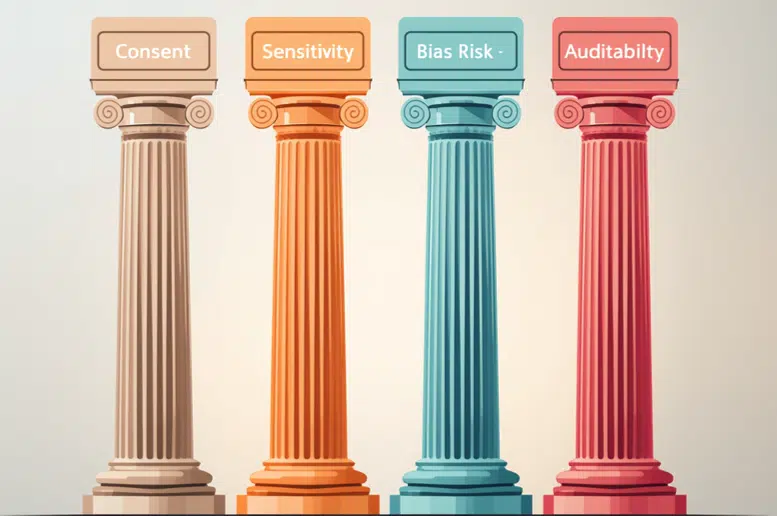
The conversation around responsible AI has matured significantly, and the conference reflected that. Responsible AI now has four concrete engineering pillars: consent, sensitivity, bias risk, and auditability.
In practice, this means:
- Redact PII at the start.
- Trace every decision made (by a human or an agent).
- Alert users when something matters; a threshold is crossed, a decision is made by an agent outside of its boundaries, etc.
- Design your system with auditability as a first-class requirement.
For us, one of the most pointed moments of the conference came from an Nvidia speaker who named what they called the lethal trifecta for autonomous agents: access, code-execution capabilities, and communication capabilities in combination. Any agent that can access data, write and run code, and communicate externally simultaneously demands guardrails built into the architecture. That combination, without constraints, is where the real risk lies.

Hardware still matters
In a conference largely focused on model APIs, orchestration layers, and agent frameworks, Traversaal.ai brought the conversation back to earth with a grounded session on GPU optimization strategies. It was a useful reminder that the physical substrate still matters, and that there is significant performance and cost to be unlocked at that level that most teams are leaving on the table.
As agent systems scale and inference costs become a real line item, the teams that understand what’s happening at the hardware level will have a meaningful advantage over those who treat it as a black box.

Final thoughts
One line from the conference stuck with us: “AI is not a use case.” It’s a capability. The companies winning with AI right now aren’t the ones chasing the flashiest model or the most impressive demos: they are the ones quietly building reliable systems, measuring what matters, and designing for the day agents are native to everything they do.
OptimizedAI made clear that day is closer than most people think. The engineering discipline to get there, however, doesn’t happen by accident. It gets built carefully, deliberately, and with the same rigor you’d bring to any production system. After all, AI is still software.
If you’re working through what production-ready agentic AI looks like for your organization, we’d love to talk. Get in touch with the Graphable team.

Graphable specializes in applied AI, graph databases, and data engineering. We help organizations move from AI experimentation to production-grade systems that deliver real business outcomes.
Graphable helps you make sense of your data by delivering expert analytics, data engineering, custom dev and applied data science services.
We are known for operating ethically, communicating well, and delivering on-time. With hundreds of successful projects across most industries, we have deep expertise in Financial Services, Life Sciences, Security/Intelligence, Transportation/Logistics, HighTech, and many others.
Thriving in the most challenging data integration and data science contexts, Graphable drives your analytics, data engineering, custom dev and applied data science success. Contact us to learn more about how we can help, or book a demo today.
We are known for operating ethically, communicating well, and delivering on-time. With hundreds of successful projects across most industries, we thrive in the most challenging data integration and data science contexts, driving analytics success.
Contact us for more information:


