
CONTACT US
Domopalooza 2026: What We’re Excited About

If you’ve never been to Domopalooza, it’s hard to fully explain what Domo does to make it special. This is their flagship conference — the one where they pull out all the stops, pack the week with mainstage stories from global brands, hands-on workshops, and a partner pavilion, and send everyone home fired up. This year, they closed it out with a private OneRepublic concert. That’s the energy of this event.
But beyond the spectacle, Domopalooza is where Domo signals where the platform is heading — and this year’s announcements told a clear story: Domo is building toward a future where AI isn’t a feature bolted onto a BI tool, but the connective tissue running through the entire data experience. As a Domo partner with deep roots in the platform, here’s what caught our attention.

AI Agents Are Becoming a First-Class Citizen
The headline theme of Domopalooza 2026 was agentic AI — and Domo isn’t treating it as a buzzword. They announced Agent Catalyst, a framework for building and deploying AI agents directly within the Domo platform and introduced an AI Agent Store where pre-built agents can be discovered and deployed across the organization.
What makes this meaningful for Domo customers is the data foundation underneath it. AI agents are only as good as the data they can access and reason over. Domo’s strength has always been in bringing together data from disparate sources into a governed, unified environment — and that turns out to be exactly what you need to make AI agents reliable rather than unpredictable. An agent operating on well-governed, connected data is a fundamentally different animal than one hallucinating answers from a poorly structured prompt.
For organizations already running their analytics in Domo, this is a significant development. You don’t have to rebuild your data foundation to take advantage of AI agents — the foundation you already have is what makes them work.
Magic ETL Got Smarter — And More Practical
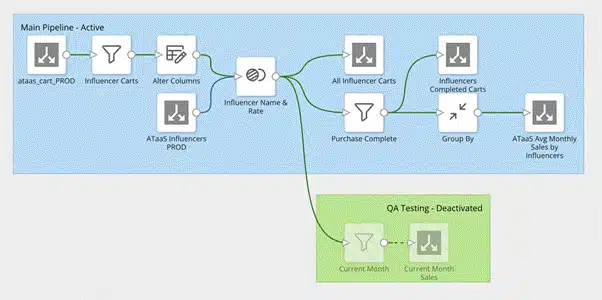
Data pipelines are unsexy but critical, and Domo made several meaningful improvements to Magic ETL that practicing analytics teams will appreciate immediately.
The most immediately useful are the workflow improvements: Disable Tiles lets you turn off a transformation step temporarily without removing it, and Run to Here lets you execute a dataflow only up to a selected step. These sound like small things until you’ve spent an afternoon troubleshooting a broken pipeline and needed exactly these tools. They’re now generally available.
Row Count Observability — showing how many rows move through each stage of a pipeline — is in beta, and it’s the kind of visibility that makes the difference between confident deployments and “I think this is right.”
The bigger longer-term update is the AI Assistant for the JSON No Code connector, expected later this year. The ability to connect to REST APIs using natural language rather than manual configuration is a meaningful reduction in the technical barrier for data integration, and it fits squarely into where the whole industry is heading.
Also worth noting: full support for Personal Data Permissions within Magic ETL dataflows is now available. For organizations managing sensitive data, this removes a real constraint — teams can work with governed data in Magic ETL without compromising existing security policies.
Documents and Unstructured Data Enter the Picture

One of the quieter but more interesting announcements was Domo Documents (formerly Filesets) — the ability to store and connect unstructured files like PDFs and images within the platform, and process them alongside structured data via a new Documents tile in Magic ETL.
For most BI platforms, unstructured data is still an afterthought. The ability to ingest a document collection, extract structured information from it, and incorporate it into a dataflow opens up use cases that weren’t previously possible without significant custom engineering. Think compliance documentation, contracts, research reports — data that lives in files rather than databases but influences decisions just as much as anything in a dashboard.
We’ll be watching how this develops. The combination of structured and unstructured data processed together is a natural fit for knowledge graph architectures, and it’s an area where Graphable’s engineering practice is well-positioned to help clients take full advantage.
Governance at Scale Gets Easier
Two admin-focused updates address something that sounds boring but matters enormously at scale: keeping governance consistent as organizations grow.
Global PDP Policies allow administrators to define a data access policy once and apply it across multiple datasets — eliminating the tedious and error-prone work of maintaining duplicate policies across a growing data environment. Column masking with calculated field support extends policy enforcement into derived fields, closing a gap that has caused headaches for compliance-conscious teams.
Together these reflect a maturity in Domo’s governance story that enterprise customers have been asking for. Governance that must be manually replicated across every dataset doesn’t scale — and Domo is addressing that directly.
The other governance-adjacent announcement worth flagging is User Impersonation — the ability for administrators to view Domo as another user to diagnose permission and access issues. This was Domo’s most requested feature on their Ideas Exchange, which tells you how much time has been spent on screenshot-and-email troubleshooting cycles. Expected in the second half of this year.
The Experience Layer Is Getting More Intentional

Two updates reflect Domo’s push to make the platform feel more organized as it grows: Nav Configs (now generally available) let administrators define consistent navigation for specific groups or the whole organization, and Workspaces (in broader beta) allow teams to create curated content hubs for specific functions or initiatives.
As Domo environments mature, content sprawl is a real problem. These tools give administrators the ability to shape the experience intentionally rather than letting it accumulate organically — which tends to mean a better experience for the end users who matter most.
What This Means for Domo Customers

Taken together, the Domopalooza 2026 announcements paint a picture of a platform that is genuinely integrating AI into its core rather than layering it on top. The Magic ETL improvements make the data foundation work better. The governance updates make it more trustworthy. The agent and document capabilities make it more capable. And the experience updates make it more usable for the people who rely on it daily.
For organizations already on Domo, now is a good time to assess whether your current setup is positioned to take advantage of what’s coming — particularly around AI agents and unstructured data processing. For organizations evaluating Domo, the direction of travel is clear.
If you want to talk through what any of these announcements mean for your specific environment, our team works with Domo clients every day and would be happy to help you think it through. Get in touch or explore our Domo consulting practice to learn more about how we work.
Graphable is a premium Domo partner with deep expertise in Domo implementation, optimization, and data architecture. We help organizations get the most from their Domo investment across every stage of the data journey.

Graphable helps you make sense of your data by delivering expert analytics, data engineering, custom dev and applied data science services.
We are known for operating ethically, communicating well, and delivering on-time. With hundreds of successful projects across most industries, we have deep expertise in Financial Services, Life Sciences, Security/Intelligence, Transportation/Logistics, HighTech, and many others.
Thriving in the most challenging data integration and data science contexts, Graphable drives your analytics, data engineering, custom dev and applied data science success. Contact us to learn more about how we can help, or book a demo today.
We are known for operating ethically, communicating well, and delivering on-time. With hundreds of successful projects across most industries, we thrive in the most challenging data integration and data science contexts, driving analytics success.
Contact us for more information:


